HONG KONG, 27 November 2025 – In a move almost unprecedented in modern Hong Kong history, Chief Executive John Lee declared a full State of Emergency at 00:47 local time tonight after a massive wildfire that erupted Wednesday afternoon in the New Territories escalated to the highest possible alarm level – No. 5 – and began threatening densely populated urban areas.
What began as a seemingly routine hill fire near Tai Lam Country Park has, in less than 36 hours, exploded into a monster that has already consumed more than 3,800 hectares of countryside, forced the evacuation of over 28,000 residents, and is now licking at the edges of Tuen Mun, Yuen Long and Tsuen Wan districts.
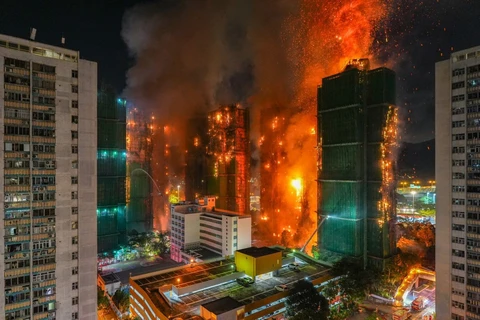
How it escalated so fast
Fire Services Director Andy Yeung briefed the press at 1:15 a.m. with visible exhaustion and soot still on his uniform:
“We have never seen a fire behave like this in Hong Kong. We are facing three deadly factors at once: bone-dry vegetation after eight weeks without meaningful rain, record-high November temperatures of 33°C, and sustained 70–90 km/h gusts from Typhoon signal remnants in the South China Sea. The relative humidity dropped to 19% today – lower than the Sahara Desert.”
By 9 p.m. Wednesday, the Fire Danger Warning had already been raised to RED. Two hours later it was upgraded to the rarely used BLACK level, and at 00:12 the blaze was officially classified as a No. 5 alarm – the first time since the 1997 Pat Sin Leng tragedy that killed four students and a teacher.
Uncontrollable spread and shocking scenes
Witnesses in Tuen Mun described “rivers of fire” cascading down hillsides at speeds faster than a person can run. Embers the size of footballs were carried more than three kilometres ahead of the main front, igniting spot fires in residential areas.
At 11:45 p.m., the fire jumped the Tsing Lun Road and engulfed the hillside directly above the Butterfly Beach area. Hundreds of residents fled with nothing but their pets and documents as flames lit the night sky brighter than daylight.
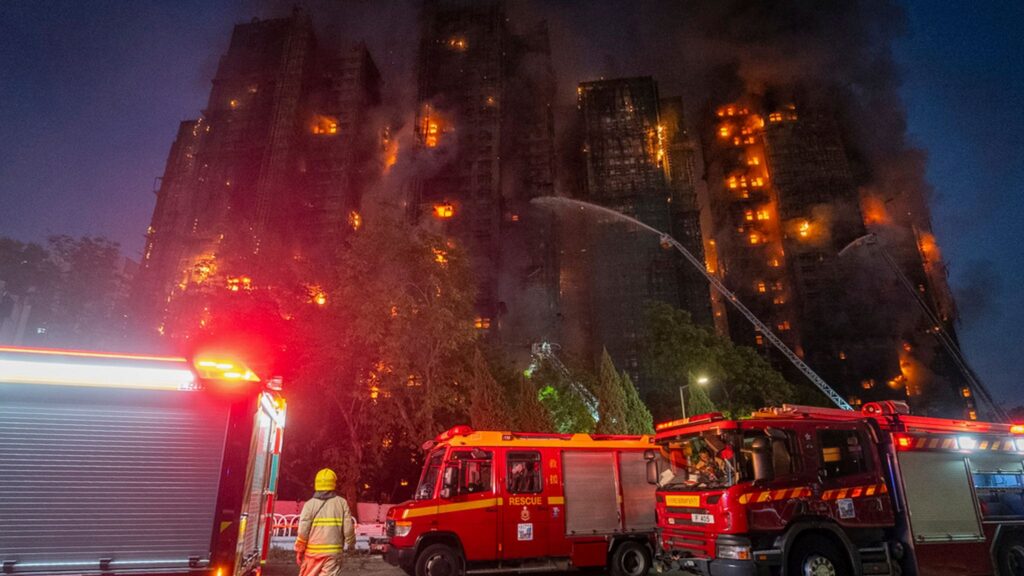
Emergency measures never seen before
Under the newly invoked Emergency Regulations Ordinance (Cap. 241), the government has taken sweeping powers:
Mandatory evacuation orders for 11 villages and six housing estates (affecting 28,000+ people)
Complete closure of Tuen Mun Highway, Castle Peak Road, and all MTR West Rail Line services north of Tsuen Wan West
Mobilisation of 1,200 firefighters, 180 fire appliances, four helicopters, and – for the first time ever – two People’s Liberation Army fire-fighting units from Shek Kong barracks
Suspension of all non-emergency flights at Hong Kong International Airport after smoke reduced visibility to under 300 metres
Schools and government offices closed territory-wide on Thursday and Friday
Chief Executive John Lee appeared live on television at 1:05 a.m.:
“This is the most serious wildfire threat Hong Kong has ever faced. I have declared a State of Emergency to ensure we can deploy every possible resource without bureaucratic delay. The safety of our citizens is my only priority tonight.”
Why can’t they stop it?
Experts say the combination of factors has created a perfect storm:
Extreme drought: Hong Kong has recorded its driest October–November period since records began in 1884.
Invasive pine plantations planted in the 1950s–70s act as “ladders” carrying fire from ground to canopy, creating explosive crown fires.
Rugged terrain and narrow access roads make it impossible for ground crews to establish containment lines.
Wind gusts up to 90 km/h are pushing embers far ahead of the main fire front, creating dozens of new blazes faster than crews can respond.
Retired Fire Services chief Lo Chun-hung told local media: “In normal hill fires, we can usually flank them and cut them off. This one is flanking us.”
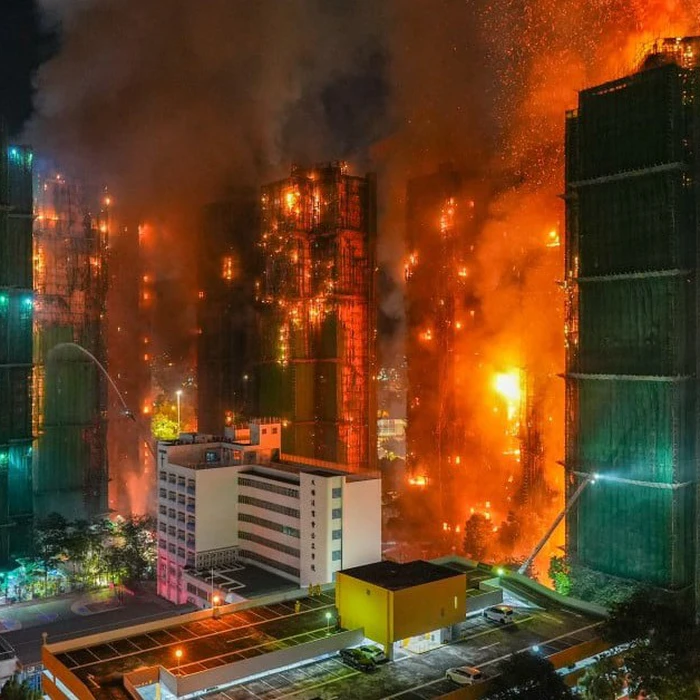
Human stories emerging from the flames
An 82-year-old woman in So Kwun Wat was carried down four flights of stairs by firefighters after refusing to leave her cat.
A group of Filipino domestic helpers formed a human chain to pass buckets of water in Fu Tai Estate before police forced evacuation.
A wedding photoshoot scheduled at Tsing Ma Bridge had to be hastily moved when the iconic structure disappeared behind a wall of smoke.
Social media is flooded with videos of wild boars, porcupines and even a leopard cat fleeing the flames into urban areas.
What happens next?
Meteorologists warn that the dangerous northeast monsoon winds will continue until at least Friday evening. A slight chance of isolated showers exists on Saturday, but forecasters say it would be “a drop in the ocean.”
The government has requested assistance from Guangdong Province fire units and is in talks with Singapore and Australia about borrowing their giant water-bombing aircraft.
As dawn approaches on this nightmare Thursday, the fire front is still advancing. Residents across northern Hong Kong are being told to keep emergency go-bags ready and windows sealed against toxic smoke.
For now, the only certainty is uncertainty. One thing is clear: the city that never sleeps is wide awake tonight – watching in horror as an unstoppable wall of flame devours everything in its path.
We will continue to update this story as it develops. Stay with us.